

Notes on a Vanishing Profession
Why the smartest people in the room refuse to see what's coming, and what happens when your profession is next.


Photo by Sergei Wing on Unsplash
I keep having the same conversation. A lawyer, or a teacher, or a doctor, or a designer, or an analyst tells me that AI is impressive, sure, but their profession is different. Too complex. Too human. I don’t understand the nuances. It requires judgment.
Every time, I think the same thing. They’ve just told me they don’t see it.
The nuances they describe are real. So is the judgment. None of that is really the question. The question is when their profession changes, and the people most likely to misjudge the timing are almost always the people most confident in their own indispensability.
This essay is about that confidence. It’s about where the confidence comes from, why it traps even the smartest people in the room, and what happens when the room itself disappears.
The Confidence Trap
The deeper you’ve dug into a craft, the harder it gets to imagine someone, or something, taking it from you. There’s nothing arrogant about that. Your brain has spent ten, twenty, thirty years building a model of how hard your job actually is. That model was expensive to build. It cost you years.
So when somebody tells you, casually, that AI is going to do most of what you do, your brain doesn’t pause. It produces a list of all the subtle, difficult, specifically human things your profession requires. The list is accurate. The list is also beside the point.
The more confidence you have in your own irreplaceability, the more deeply you’ve invested in the very model that’s about to break.
The Napster Moment
Remember Napster. Late nineties. A small piece of software that let people share music for free. The record industry laughed at first, then sued, then went quiet, and then either became Spotify or stopped existing.
The interesting thing was never the technology. It was the speed. Roughly eighteen months separated “curiosity for nerds” from “the business model is punctured.” There was no time for the industry to be in denial. It just woke up one morning as a different industry.
Education will have its Napster moment too. I can’t tell you exactly when, though I suspect we’re closer than most people think. When any student can rent an infinitely patient tutor tuned to them personally for the price of a coffee, what’s supposed to happen to two hundred undergraduates listening to a man in his fifties read off his slides?
You can play this game with any profession. What does the Napster moment look like for lawyers, for radiologists, for graphic designers, for middle managers, for journalists, for programmers? The question is no longer whether it arrives. The question is which floor of the building you happen to be on when the elevator starts to fall.
Pyramids fall floor by floor. The modern organization assumes you need many hands to produce, a few eyes to oversee, and one or two brains to steer. AI works on this structure the way termites do, eating it from underneath. A junior role that used to require five people now runs with two. The middle manager who coordinated those five has less coordinating to do. The director who led three middle managers gets by with one. The pyramid still stands. It’s hollow inside. And the higher you sit, the longer it takes you to notice. You look down at a team that still delivers, and you assume everything’s fine. You don’t see the floor beneath you getting thinner every month.
Two Concepts Your Brain Refuses to Hold
Of all the things humans are bad at, two stand out. One is infinity, which any math teacher can tell stories about. The other is exponential growth.
The research here is consistent and slightly humiliating. People systematically underestimate exponential curves and perceive them in linear terms. The effect is called exponential growth bias, first documented in 1975 by Wagenaar and Sagaria, and confirmed over and over since, including during covid. Even people who know about the bias get fooled by it. Even people who really should know better. Higher education barely reduces the effect. It’s the brain’s default setting.
Now consider the timeline. Homo sapiens has been around for roughly 300,000 years. For 99 percent of that time, we lived as hunter-gatherers. Agriculture is about 12,000 years old. The Industrial Revolution is 250 years old. The internet is 30. The smartphone is 18. ChatGPT is barely 3.
Plot all of that on a timeline and the whole of modernity stops looking like a stretch. It looks like a dot. And inside that dot, everything is accelerating. Not steadily, either.
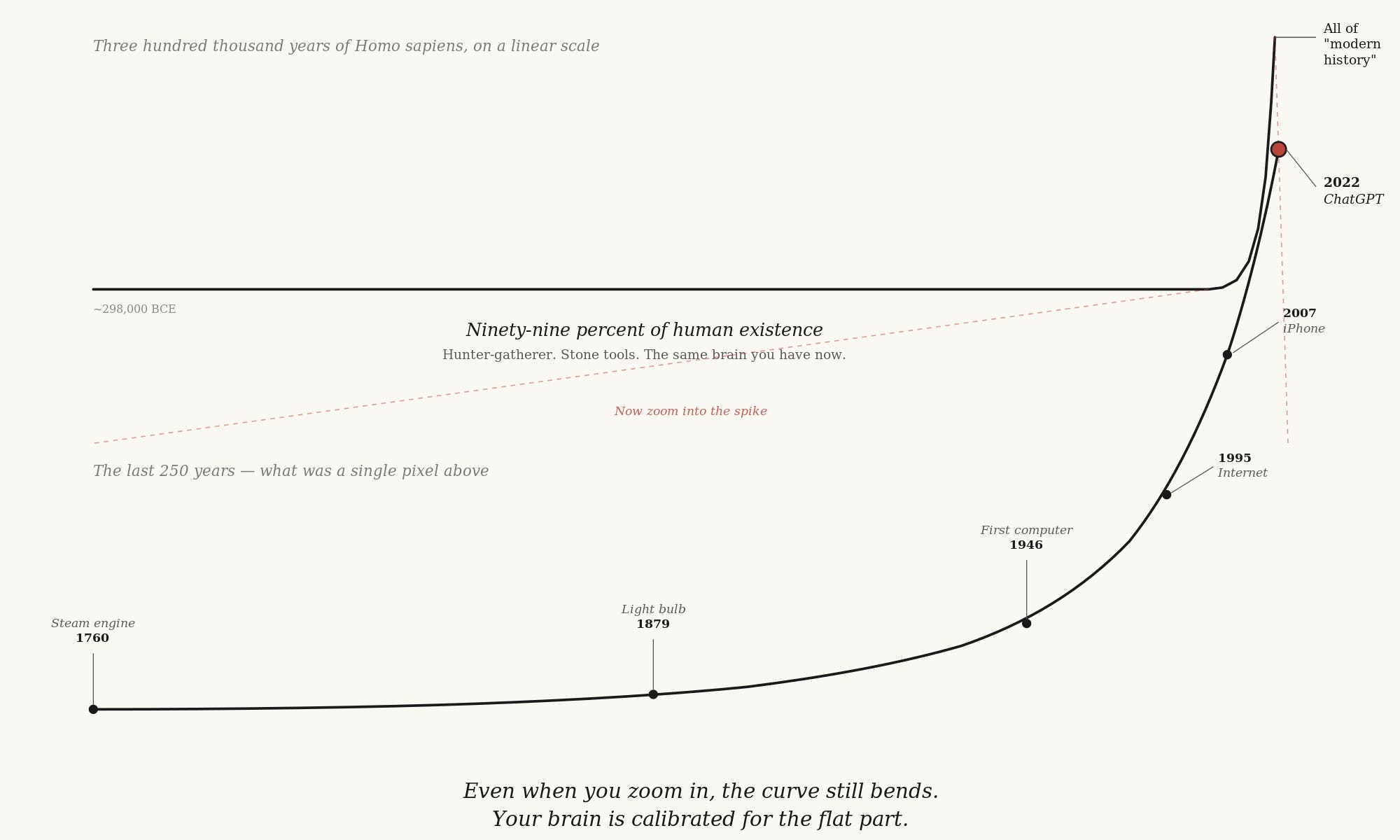
Your brain is calibrated for the savanna. It expects tomorrow to look much like today. When something has grown fast, your brain expects the growth to slow. That’s a sensible intuition for a world of finite resources, where scarcity pushes prices up and bottlenecks tighten.
AI doesn’t grow like that. Each improvement makes the next improvement easier. So the curve doesn’t flatten where it should. It bends harder.
Bubbles don’t look like this. Compounding does.
People say “AI is a bubble” today with the same confidence people once said “the internet is a fad.” They have a model. The model doesn’t fit this phenomenon.
The S-Curve, Or Was It an I?
We like to comfort ourselves with the idea that all exponential growth eventually becomes an S-curve. That it flattens. That nature has a built-in brake somewhere. Eventually, this is probably true.
The real question is where on the S we’re sitting right now.
If we’re near the bottom, then the rest of your career fits inside the steep middle. You’ll never see the flattening. You’ll experience the climb every day, and every day you’ll underestimate how much steeper it’s about to get.
Or, as I sometimes tell myself on humbler days, maybe we aren’t in an S at all yet. Maybe what we’re looking at is still just an I.
I’m not writing this to scare anyone. I’m writing it because it strikes me as strange how few people are taking it seriously, and how many are defending the status quo with arguments that would have been valid ten years ago, and aren’t now.
Confidence in your own profession is a fine thing. It isn’t a defense against technology.
The first step is admitting it’s coming. The second is sitting down and asking, plainly, what you would do if you knew, for certain, that your job would look completely different five years from now.
That isn’t a rhetorical question.
That’s the homework.
This was the first post. If it resonated with anything in you, good or bad or irritating, I’d like to hear it. Subscribe if you’d like more of this kind of thinking in your inbox.